
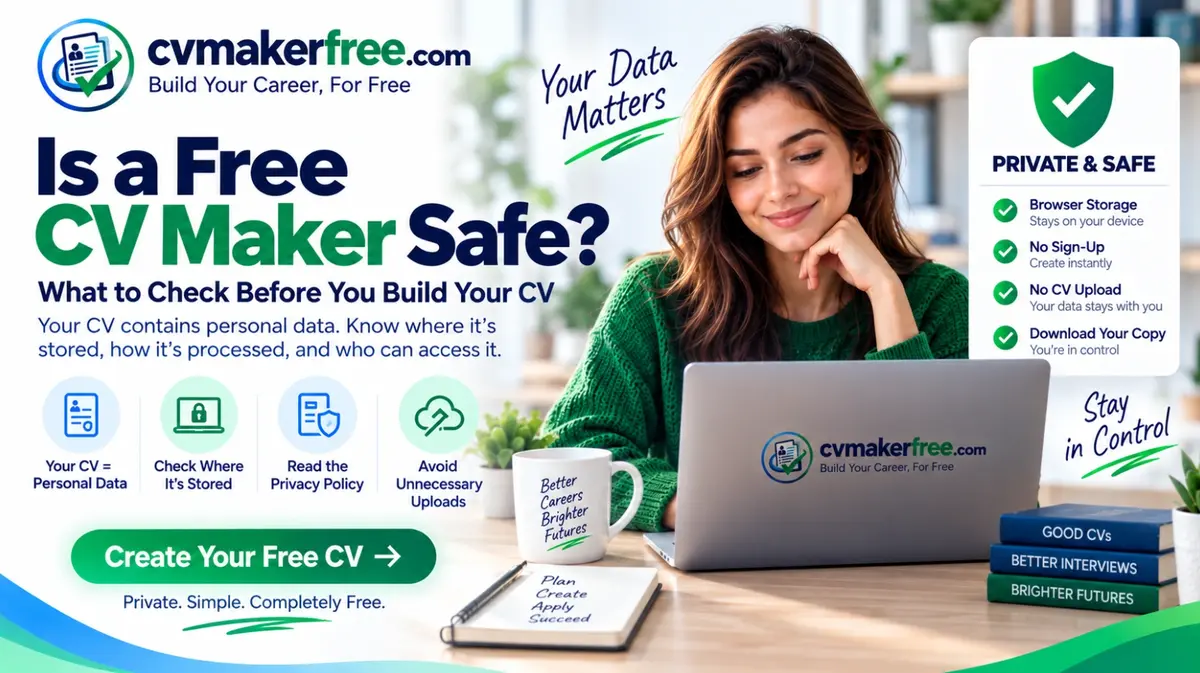
Is a free CV maker safe to use?
Usually, but it depends entirely on where your CV is processed. A free CV maker that builds the document in your own browser never receives your personal data at all. One that uploads your CV to a server is holding a file full of your name, address, phone number and employment history — and you should know its retention policy before you use it.
What is actually at risk in a CV?
A CV is one of the most concentrated pieces of personal data most people ever produce. In a single file it typically carries your full name, home address, personal email, mobile number, your employment history with dates, and often the names of referees. That combination is valuable to identity thieves and to the data brokers who resell CV databases to recruiters.
The realistic risks are not dramatic hacks. They are mundane: a CV database sold on, a recruiter marketing list you never opted into, or an account you created once and cannot delete.
What should you check before using one?
- Where is the CV processed? If the tool states that content stays in your browser, your data never leaves your device.
- Does it require an account? An account means a stored copy and an email address on a list. A tool that works without sign-up holds nothing to leak.
- What does the privacy policy say about retention? Look for how long files are kept and whether they are used for anything beyond generating your document.
- Is the download watermarked or paywalled at the last step? A “free” builder that demands payment once your CV is written has your data and your effort as leverage.
- Does it share data with third parties? Almost every site uses analytics and many use advertising. That is normal, but it should be disclosed, and it should be separate from your CV content.
How does CV Maker Free handle this?
The CV you write in CV Studio is held in your own browser’s local storage and is not uploaded to or stored on our servers. There is no account to create and no email address required to build or download a CV. The ATS checker analyses pasted text within the request and discards it rather than writing it to a database.
Separately from your CV content, this site uses analytics and advertising services in the ordinary way that websites do, which involves cookies. Those are described in our privacy policy and cookie policy. The distinction worth understanding is that site analytics and your CV are two separate things: the first is standard web measurement, the second never reaches us.
One practical consequence of browser storage is worth knowing: because your CV lives on your device, clearing your browser data deletes it. Download a copy when you finish.
Are paid CV builders safer than free ones?
Not inherently. Paying changes the business model, not the architecture. A paid service still stores your CV on its servers if that is how it is built, and a subscription gives it a reason to keep your data and your account active. What matters is where the processing happens and what the policy says, not the price.
Frequently asked questions
Can a free CV maker sell my data?
Only if it holds your data in the first place. A tool that processes your CV in the browser has nothing to sell. A tool that requires an upload and an account does, so read its policy before you use it.
Should I put my full address on my CV?
Increasingly, no. Town and country are enough for most applications, and they are all a recruiter needs to judge your location. Leaving off the street address reduces what is exposed if the file is ever mishandled.
Is it safe to email my CV as a PDF?
Yes, for a normal application to a named employer. Be more careful about uploading it to job boards that syndicate listings, since that is how CVs most often end up in databases you never chose.