
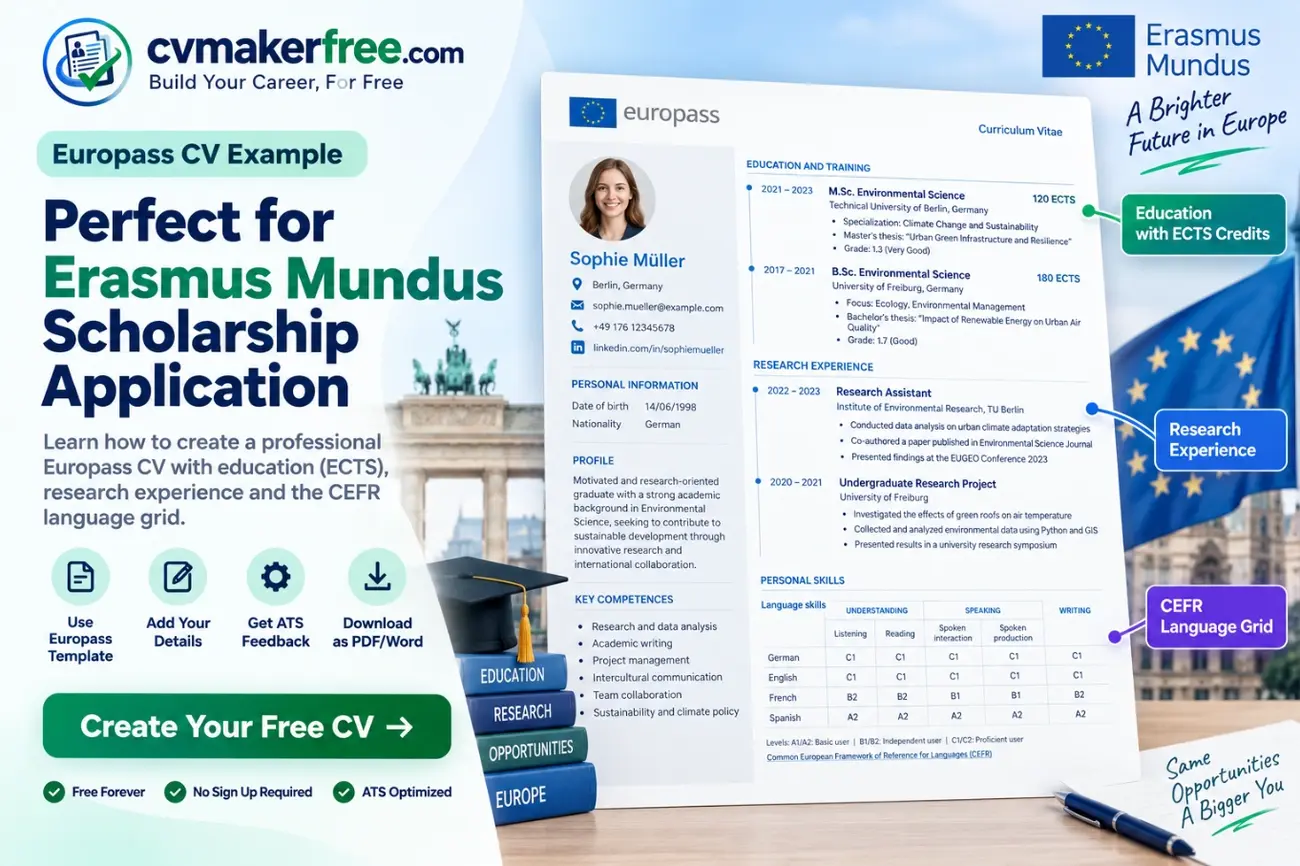
How to Make a Europass CV for the Erasmus Mundus Scholarship
To make a Europass CV for Erasmus Mundus scholarship, use the official EU format and lead with education, research and academic output rather than employment. Include your degree with ECTS credits and grading scale, CEFR language levels, mobility and international experience, publications, and any research or fieldwork. Keep it to two or three pages, name the exact programme you are applying to, and check the consortium’s own document list — some require Europass specifically, while others accept any professional CV format.
Erasmus Mundus Joint Masters (EMJM) are among the most competitive scholarships in the world. A consortium may receive well over a thousand applications for twenty funded places, and the selection committee reads your CV alongside your motivation letter as a single evidence file. This guide covers what that committee is scoring, and how to structure a Europass CV so it scores well.
Does Erasmus Mundus require a Europass CV?
It depends on the consortium, and this is the first thing to check. There is no single central Erasmus Mundus application — each joint master’s programme runs its own portal, sets its own deadline, and publishes its own list of required documents. Some explicitly require the Europass format. Many accept any clear, professional academic CV.
The practical rule: if the programme names Europass, use Europass. If it does not specify, Europass is still the safer choice, because your file is being read by European academics who use that format daily and expect its structure. It also forces you to declare CEFR language levels and EQF qualification levels, which are exactly the fields a European selection committee wants to see filled.
You can build one free in the Europass CV maker without registering, then export a PDF ready to upload.
What the selection committee is actually scoring
EMJM consortia typically evaluate on academic excellence, motivation, relevance of your background to the programme, language ability, and international or professional experience. Your CV carries the evidence for four of those five. Read the programme’s published selection criteria — most publish a weighted rubric — and make sure every criterion has a corresponding entry on your CV.
| Selection criterion | Where it lives on your Europass CV |
|---|---|
| Academic excellence | Education section: degree, GPA with scale, class rank, ECTS, honours |
| Relevance of background | Thesis title, principal subjects, relevant coursework, projects |
| Research potential | Publications, conference posters, research assistantships, methods used |
| Language ability | Language section with CEFR levels plus test scores |
| International exposure | Exchanges, summer schools, volunteering abroad, cross-border projects |
| Professional experience | Work experience section, framed around transferable research skills |
How to structure a Europass CV for a scholarship application
The Europass format is fixed, but the order and weight you give each section are yours to control. For a master’s scholarship, education outranks employment.
1. Personal information
Name, address, phone with country code, email, nationality and date of birth. Unlike a UK or US CV, these fields are normal and expected here — nationality matters because consortia maintain geographical balance across their intake, and eligibility rules distinguish applicants by country of residence.
2. Position applied for
Name the exact programme and intake: “Applicant, Erasmus Mundus Joint Master in Environmental Sciences, Policy and Management (MESPOM), 2027–2029 intake.” A generic CV uploaded to five portals is visible, and it reads as low commitment.
3. Education and training
This is your most important section. For each qualification give:
- Full degree title and dates
- Institution, city, country
- Grade with the scale explained — “CGPA 3.72 / 4.00” or “First Division, 82%, where 70%+ is the highest band”. A committee in Belgium cannot interpret your national grading system unaided.
- Class rank if strong — “ranked 3rd of 148”
- ECTS credits — EMJM eligibility usually requires a first degree of at least 180 ECTS, so state your total or its equivalent
- EQF level — bachelor’s is typically level 6, master’s level 7
- Thesis title and supervisor, plus one line on method and finding
- Principal subjects — list the six to eight modules that map onto the programme you are applying to, not all forty
4. Research experience and publications
Add this as a custom section directly after education. Even one entry lifts you above applicants who have none.
Undergraduate Research Assistant — Department of Environmental Sciences, Quaid-i-Azam University
Jun 2024 – Apr 2025
Collected and analysed water-quality samples from 14 sites along the Soan River. Ran statistical analysis in R and co-authored a departmental report cited in a district policy submission. Presented findings as a poster at the National Environmental Conference 2025.
List publications in a consistent citation style. Include papers under review, marked honestly as such. Conference posters, workshop presentations and preprints all count — do not leave them out because they are not journal articles.
5. Language skills
Europass asks you to self-assess each language across listening, reading, spoken interaction, spoken production and writing on the CEFR scale (A1 to C2). Complete the grid properly and add your actual test result alongside: “English — C1 (IELTS Academic 7.5, Nov 2025)”. Most EMJM programmes require proof of English at roughly B2 to C1, and some require a second European language for specific mobility tracks. Do not inflate a level you cannot defend in an interview.
6. Digital and technical skills
Name the tools, not the adjective. “R (tidyverse, spatial analysis), QGIS, Python, SPSS, LaTeX, Zotero” tells a committee you can start research work immediately. “Good computer skills” tells them nothing.
7. Work experience
Include it, but frame it for an academic reader. A teaching assistantship, an NGO field placement or a lab internship is worth more here than a well-paid unrelated job. For each role, emphasise transferable research and analytical skills, and add numbers where they exist.
8. Additional sections worth adding
- International experience — exchanges, summer schools, field trips, model UN, cross-border projects. EMJM is a mobility programme, so evidence that you function in unfamiliar countries is directly relevant.
- Scholarships, awards and honours — merit awards signal that others have already assessed you competitively.
- Volunteering and leadership — society roles, tutoring, community projects. Consortia value social contribution.
- Certifications and training — MOOCs, methods workshops, fieldwork or safety certification.
What Erasmus Mundus funding covers
Scholarships are calculated on a monthly unit cost — commonly cited at €1,400 per month for up to 24 months, giving a maximum of around €33,600 — which contributes towards participation costs, subsistence, travel and installation, with a tuition waiver for scholarship holders. Exact amounts are set in the Erasmus+ Programme Guide for each call year and can change between cycles, so confirm the figure on your target programme’s own funding page rather than trusting any blog, including this one.
The application timeline
- Aug – Sep: Shortlist programmes from the official EMJM catalogue and read each consortium’s selection criteria
- Oct – Jan: Deadlines fall in this window for most programmes, though each sets its own date
- Before you submit: Have your degree certificate, transcripts, language certificate, two or three reference letters, motivation letter and Europass CV ready
- Feb – Apr: Selection results, including reserve lists
- May – Aug: Acceptance, visa process and pre-departure
Note the eligibility detail that catches people out: you generally must already hold your first degree by the programme’s admission deadline, and applicants who have previously held an EMJM scholarship cannot receive another. Consortia also apply geographical balance, so a limited number of scholarships go to applicants of any single nationality across the project’s lifetime.
Seven mistakes that weaken an Erasmus Mundus CV
- Leaving Europass fields blank. Empty labelled sections are visually obvious in this format. Fill them or remove the section.
- Giving a GPA with no scale. “3.4” is meaningless without “/4.0” and a note on what counts as strong locally.
- Sending the identical CV to five consortia. Change the “position applied for” field and reorder your relevant coursework each time.
- Hiding research under work experience. Give it its own section, above employment.
- Overstating language levels. C2 on the CV and hesitancy in the interview ends the application.
- Running to six pages. Two to three pages. Committees read hundreds of files.
- Contradicting your motivation letter. Dates, titles and claims must match exactly across every document you upload.
Should your Erasmus Mundus CV be ATS-friendly?
Scholarship files are read by humans, not applicant tracking software, so parsing is less critical here than in a job application. What still matters is that your PDF contains real, selectable text — some university portals index uploads, and a scanned image of a printed CV is unreadable to everyone. If you plan to reuse the same content for internships or graduate jobs later, run that version through the ATS CV checker first, since the Europass layout is not the best choice for corporate applications.
Frequently asked questions
Is a Europass CV mandatory for Erasmus Mundus?
Not universally. Each consortium publishes its own document requirements — some name Europass specifically, others accept any professional academic CV. Check your programme’s application page, and use Europass when it is unspecified.
How long should an Erasmus Mundus CV be?
Two to three pages. Three is reasonable if you have publications and research experience; six pages of padding works against you.
How many Erasmus Mundus programmes can I apply to?
You can apply to several, but scholarship applications are capped — commonly at three programmes per intake. Confirm the current limit in the official catalogue before submitting, as the rule is set per call year.
Can I apply without work experience?
Yes. EMJM is a master’s scholarship assessed primarily on academic merit, motivation and potential. Your thesis, coursework, projects and any research assistance carry the weight.
Do I need IELTS for Erasmus Mundus?
Most programmes require proof of English proficiency, usually IELTS or TOEFL at around B2 to C1. Some waive it if your previous degree was taught entirely in English, but a certificate strengthens your file either way. Check the specific consortium.
Should I include a photo on my Erasmus Mundus CV?
The Europass format allows one and it is unremarkable in European academic applications. It is optional and will not affect your score either way.
Build your Europass CV now
Fill the official EU structure — personal information, EQF levels, CEFR language grid — without wrestling with the online editor, then download a clean PDF to upload to your consortium’s portal. No account, no watermark, no fee. Make your free Europass CV →